


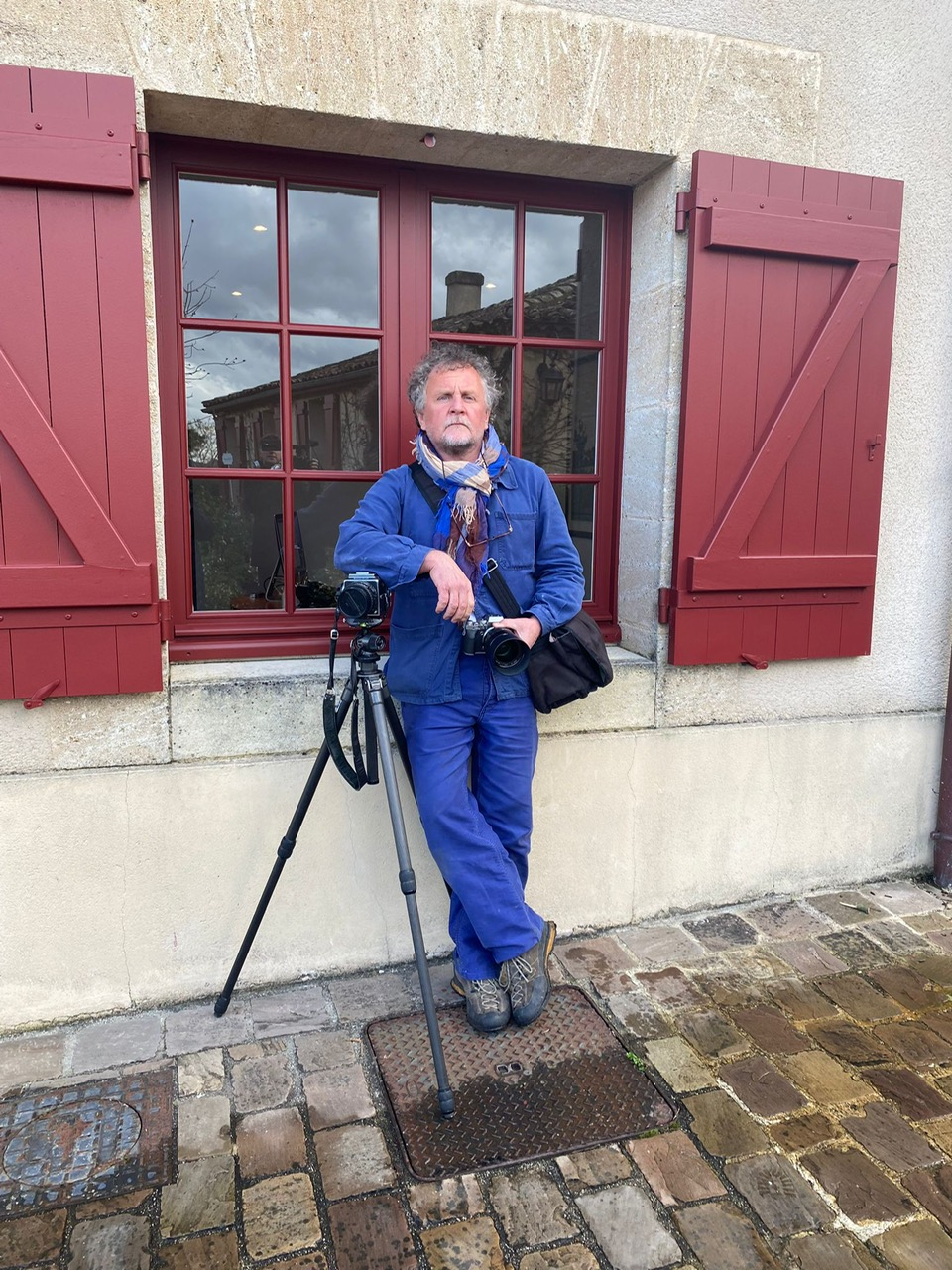
Jason Lowe has spent his career photographing the world's food cultures at their source – on farms, in fermentation rooms, and at the tables of some of the most important restaurants of his generation. He began as an assistant in London aged 17, honed his eye under a meticulous mentor in a Soho studio, and found his calling on a commission in India that opened the door to a life spent documenting where food comes from. His long collaborations with St. John and Magnus Nilsson, among many others, have made him one of the most respected names in food photography.
Could you tell our community a little about yourself and what you do?
I've basically been a food, travel, and food photographer for the whole of my life, starting as an assistant in London aged 17. I had a motorbike and was a motorcycle courier – that's how I met the photographer who became my mentor. I stayed with him for five years in a black box underground in the centre of London, taking photographs very, very slowly and with a lot of observation, a lot of detail, a lot of care. A normal shoot could take like six weeks. From there I set up myself, travelled around the world, built a portfolio, and came back to London to sell myself. Then one day I got a call asking would I like to go to India to photograph a story about basmati rice – and after a couple of days there it was like an epiphany. I'm travelling, I'm taking photographs, and the doors are being opened into my most favourite subject, which is the origins of food. And I'm being paid for it. This is what I'm going to do for the rest of my life.
What are you working on at the moment – and what is exciting you right now?
Three long-form projects. The first is documenting Magnus Nilsson's new restaurant, Furuhem in Båstad in Sweden. I first photographed Fäviken for Bon Appétit in the early days and we've stayed close. When Magnus announced the opening, I rang him straight away and said I think this process needs to be documented. He agreed. I've been going regularly for the last 18 months and it's now open seven days – it's a great project that will likely evolve into other things.
The second is an option I'm working on for a documentary series based on Dan Saladino's book *Eating to Extinction* – which I found so compelling, particularly the real optimism in the people working to stop things disappearing. I'm heading to Georgia to start research on the chapter about Georgian wine, the idea that wine started there 8,000 years ago, and the extraordinary variety of grapes and soil types they have.
The third is entirely self-motivated – a book, working title *Vineyard Lunches*, which mixes all my interests: low-intervention winemakers making wine in difficult conditions or difficult places, the food of those places, and the connection between the two. It'll be set over a lunch, with some recipes and conversations with winemakers from extreme places like Slovakia and La Palma in the Canaries. Long work, low value financially, but deeply close to my heart.
What do you most enjoy shooting – the dish, the ingredient, the chef, or the room?
They only exist as the compilation. The stories are always a collection of images – things don't live in isolation, they live like nature in community with each other. If you're going to push me for an answer, it's the combination of a human interacting with something they love to do. If it's a fisherman, it's all about concentration and intent. A chef cooking, it's watching closely the process they're going through. The centre of it is the human in combination with nature.
What makes a food photo exceptional?
I don't think you can fake it. An exceptional photograph is made with the understanding of what's gone into it. The beauty in ugliness, if you like – the beauty in the things you don't really think could be amazingly beautiful. My work has always been about the purity, the honesty of the actual thing. If the dish has integrity, then beautifully and naturally lit – not flash, but being mindful of beautiful natural light – and a good plate. I don't think it needs a lot of adornment. The food on the plate speaks for itself.
What would your message be to the food enthusiast who takes pictures of every dish at a restaurant?
I do it myself, so I can't be too hypocritical. But I think it's really important to not let things get cold and to enjoy the company of the people you're with and to enjoy the meal that somebody has worked exceptionally hard to bring from the kitchen – and somebody has worked exceptionally hard to grow the food. As a matter of respect, I think one should be careful with it. Be mindful of your surroundings, your friends, the people you're with, and be mindful and respectful of the chef and the staff.
Any one piece of advice for an amateur photographer?
If you can, do it in daylight – top lights are a disaster because you're constantly trying to avoid the shadow of your phone in the plate. Switch it to portrait mode, and try to get as much of the food in the frame rather than the surroundings.

Any London restaurants you return to again and again?
St. John – I went on a Saturday when it opened in 1994 and was there very early on. It's born a lot of friendships, a lot of love, a lot of experience, a lot of work that I'm really proud of. A great institution.
Smoking Goat – the Thai food is always really good, very believable but with real care in the sourcing of ingredients. Good natural wine list too.
Tiella – it's an Italian place in Columbia Road and the chef came from Brawn. It feels like that moment when you're driving around Italy and you just stop for lunch and it's so good. Tiella tastes like really good, simple Italy.
Brawn, just down the same street, is a great institution too – the food is always good, the wine is fabulous, and Ed has a great touch.
Any favourite food destinations beyond the UK?
Bangkok is my favourite eating city. There's a place called Ji Jong Hwo that just makes their own noodles and does a duck noodle soup – it's a family thing, the noodles are made upstairs, there's a big stockpot, it's very simple but absolutely stunningly delicious.
Little Egg in Brooklyn, NYC – Evan Hanczor and Little Egg is the best brunch place. He's an amazing man.
La Merenda in Nice – in this restaurant I love the fact that there are only 22 recipes throughout the year. I've never had a bad meal there. And if you eat on your own, they always put the jug of flowers opposite you so that you have company.
What's the most memorable restaurant experience you've had?
Absolutely no question – Fäviken, up in Northern Sweden. I went seven times. The first time, I couldn't believe it: a restaurant with only 12 seats, it seemed completely out of this world. Chef Magnus Nilsson did it with such genuine integrity and intention that every single thing came with a marvel, and it never felt like he was trying to show off. Everything had depth of reason behind it.
You stayed the night in a humble barn with a sauna and woke up to what was probably the best breakfast of all time. The combination of having to really dedicate yourself to the journey – at least four days from London – meant you felt genuinely invited to commit to something. And on every occasion you were rewarded with something beyond gastronomy. Whether it was a curious mead or some strange juice or the shrivelled apple that had sat in the sauna for six months. It was a kind of gastronomic performance art.
Who would you like to see in our Member Highlight Series?
Pat Mahoney, drummer for LCD Soundsystem. He’s a lover of low intervention wine and eating!!


