

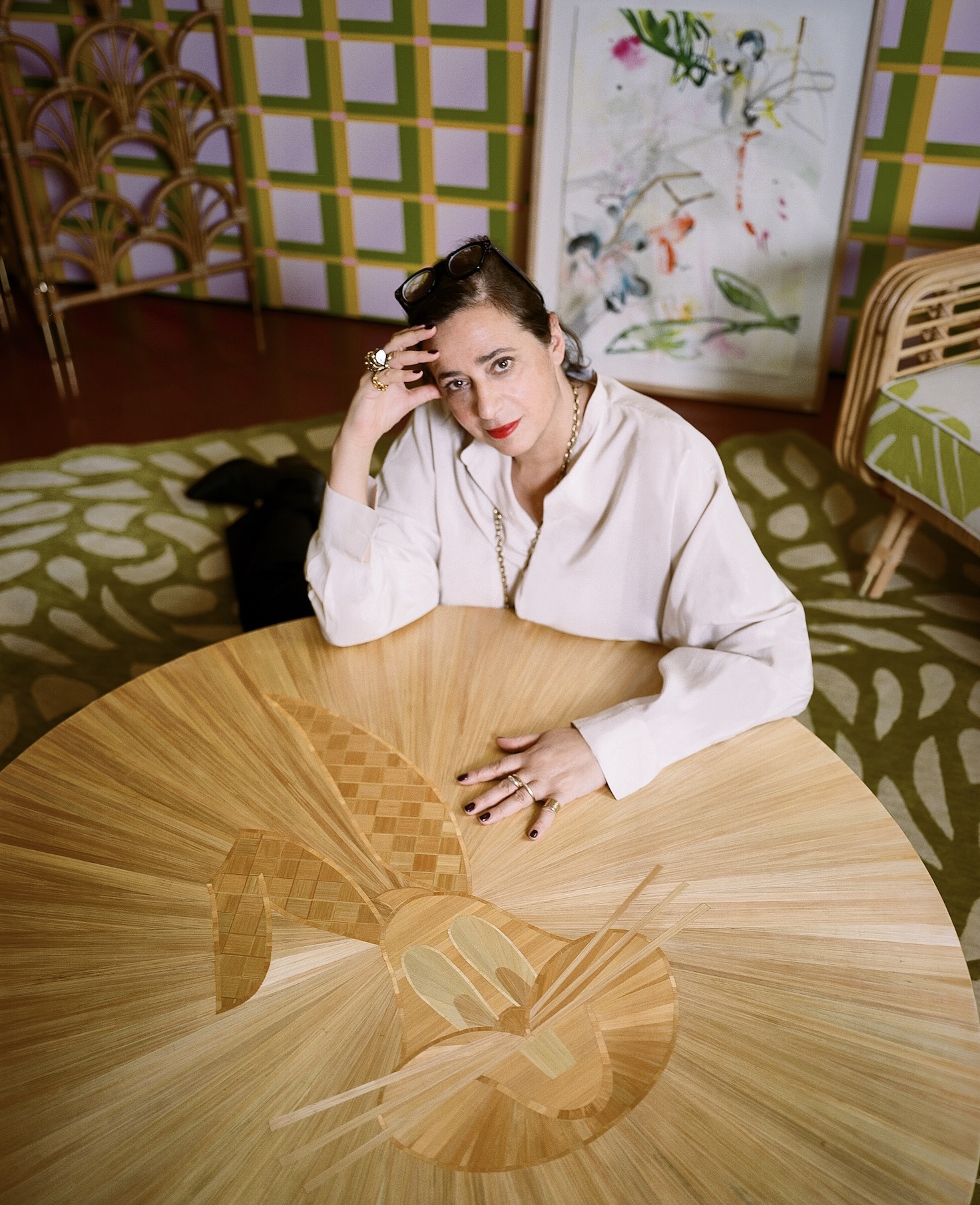
India Mahdavi is a Paris-based Iranian-French architect and designer known for her expressive use of colour, form and atmosphere. Born in Tehran and raised across the United States, Germany and France, she began her career with designer Christian Liaigre before opening her own studio in Paris in 2000. Her work spans architecture, interiors, furniture and objects, with projects ranging from private residences and hotels to restaurants and cultural institutions. Among her best-known works are The Gallery at Sketch in London, the historic rooms of Villa Médicis in Rome and PoMo museum in Trondheim.
Could you tell our community a little about yourself and what you do?
I am a Paris-based architect and designer. Over the course of my career I have worked across many scales and typologies – from private residences and cultural institutions to hospitality projects around the world. What ties everything together is an obsession with emotion: how an ephemeral moment in a particular space can create everlasting memories-
What are you working on at the moment – and what’s exciting you right now?
I have been focused lately on a number of institutional and cultural projects, which I find particularly stimulating. Among them: PoMo, a contemporary and modern art museum in Trondheim, Norway; an intervention at the Villa Médicis in Rome; and the Orangerie at the Beyeler Foundation. Alongside those, I am working on residential projects in several parts of the world – from New York , to the south of France
On the objects and collections side, I have been developing pieces for Baccarat and Sèvres, and a fabric collection with La Maison Pierre Frey. There is something very grounding about working at that intimate scale in parallel with larger architectural projects.
What’s the most important thing to get right in a restaurant or a hotel?
The lighting and the food – in that order, and without compromise on either. You can forgive many things in a restaurant, but not bad light. It changes how people look at each other, how the food reads on the plate, how long you want to stay.
What’s the most overused cliché in restaurant design right now?
Nostalgia – the deliberate effort to make a space look as though it has always existed, as though it were discovered rather than designed. There is a fine line between patina and pastiche, and right now that line is being crossed everywhere. Authenticity cannot be manufactured. Guests feel the difference immediately, even if they cannot name it.
And Nostalgia killls the future.

What do most restaurateurs underestimate?
The silence between the gestures. They invest enormously in the visible – the furniture, the brand, the chef – and underestimate everything that is felt without being seen: the acoustics, the temperature, the pace of service, the smell when you walk in. A great restaurant is a complete sensory score. If even one instrument is out of tune, the whole experience suffers.
What would you tell someone planning their next project?
Start with the experience, not the brief. Before you think about materials or references or budgets, ask yourself: how do I want people to feel when they are here? What do I want them to remember a week later? Everything else – the design, the programming, the lighting plan – is in service of that answer.
What are three hometown restaurants you return to again and again – and why?
Du Pain et des Idées, rue du Bac: I keep coming back for the croissants, the pavé bread and the sense that some things should never change.
Yen is a Japanese restaurant on rue Saint-Benoît and it’s precise, quiet, and perfect. Their soba is among the best I have eaten anywhere in the world.
Chez Georges, rue du Mail: still one of the most genuinely Parisian experiences in the city. The food, the service, the charm, the décor: nothing is performed. It simply is. That is increasingly rare.

Where would you take a friend visiting Paris – and why?
Almost certainly to Chez Georges or Sant Ambroeus – for the crowd as much as anything else. There is a particular kind of Parisian energy in those rooms that you cannot stage or replicate.
Have there been any new openings you’ve found inspiring – and why?
My friend, the architect Sophie Dries, has just opened the smallest and most precise café on rue de Bellechasse – directly across from my own spaces on rue Las Cases. It is called Quartz, and it is exactly what the street needed.
The specialty coffee is from Partisan, the roaster, alongside pastries – including vegan and gluten-free options – from the culinary studio Toutia. Everything is served with water filtered through minerals, including quartz, which gives the place its name. There are ceramics and glass candleholders to discover and buy, a speaker by Mateo Garcia, and barista textile accessories created in collaboration with L’Uniform.
If you had to choose three favorite food destinations, what would they be – and which places do you recommend in each?
Arles
Arles is always the first answer. I have a house there, so I am perhaps biased – but I genuinely believe it is one of the most exciting places to eat in France right now.
Three addresses I return to without hesitation:
La Chassagnette, with chef Armand Arnal, is something apart. The garden is the kitchen – everything grown on the land surrounding the restaurant, in the Camargue. Armand has a rare quality: his cooking is deeply rooted in the territory without ever feeling folkloric. It is precise, generous, and alive. Lunch there in summer, under the shade of the trees, is one of my great pleasures.
Inari, with Celine Pham – a Vietnamese sensibility applied to the extraordinary local produce of Provence. The combination sounds unexpected and tastes completely inevitable. Celine has an exceptional palate and a lightness of touch that I find very moving. It is the kind of cooking that makes you pay attention.
And then Nord Pinus – the legendary hotel on the Place du Forum, where chef Antonio Altamura has brought the kitchen back to life with enormous care and intelligence. His cooking honors the Arlesian terroir while carrying the full weight of his Italian sensibility.

Rome
Rome is a city I always go back to because of my work at the Villa Médicis , and the table there is inseparable from the setting – the light, the stone, the particular chaos of the streets. A few addresses I love:
Osteria del Coppelle – a beautiful terrace, a relaxed and convivial atmosphere, and exactly the kind of Roman cooking that reminds you why simplicity is the hardest thing to achieve.
Teatro della Comèta – This place belongs to my friend Maria Grazia Chiuri and it's perfect for a quick lunch.
Trattoria Da Enzo, in Trastevere – a genuine cult. No reservations; you add your name to a list and you wait, and it is entirely worth it. Old school, no concessions, extraordinary food. The kind of place that makes you understand what Roman cooking actually is.
Pier Luigi – the best seafood in Rome, and a wine list to match. This is where I go when I want to celebrate something, or simply when I want to eat very, very well.
Modena
The the kingdom of Massimo Bottura, Modena. But beyond Osteria Francescana, which needs no introduction, two addresses I find just as compelling in their own way:
Guilia – intimate, precise, deeply rooted in the Emilian tradition.
Cavallino – Bottura’s more recent project, and one of my favorites: fast cars, slow food in the heart of Emilia-Romagna. It occupies a historic Ferrari canteen, and the spirit of that heritage is present in everything – the energy, the precision, the pride of place. It is joyful and serious in equal measure.

What’s the most memorable restaurant experience you’ve had – and what made it so special?
I return to Adrère Amellal every year, in the Siwa Oasis in Egypt, and I think it may offer the most beautiful food experience I know. It is a modern interpretation of traditional Egyptian cuisine – everything organic, everything from the garden or the surrounding land.
What I love most is breakfast: a date omelette that sounds simple and is somehow revelatory, date soufflé, olive jam on bread still warm from the oven. Nothing is imported, nothing is unnecessary.
And then the setting: every meal served by candlelight, in rooms built from kershef – the local salt rock and mud mixture – with walls that seem to have grown from the earth rather than been constructed. There is no electricity as such. The silence is absolute. You lose track of time in the best possible way.
It reminds me, each time, why I believe so strongly that the greatest hospitality experiences are never about luxury in the conventional sense – they are about a kind of radical integrity between place, people, and what is on the table.
Who would you like to see in our Member Highlight Series?
Sophie Dries – architect, curator, and the person behind Quartz. She has one of the most rigorous and poetic sensibilities in Paris right now.
Omar Sosa – art director and creative force based in Barcelona. He has shaped how an entire generation thinks about interiors, living, and visual culture.
%20(1).jpg)